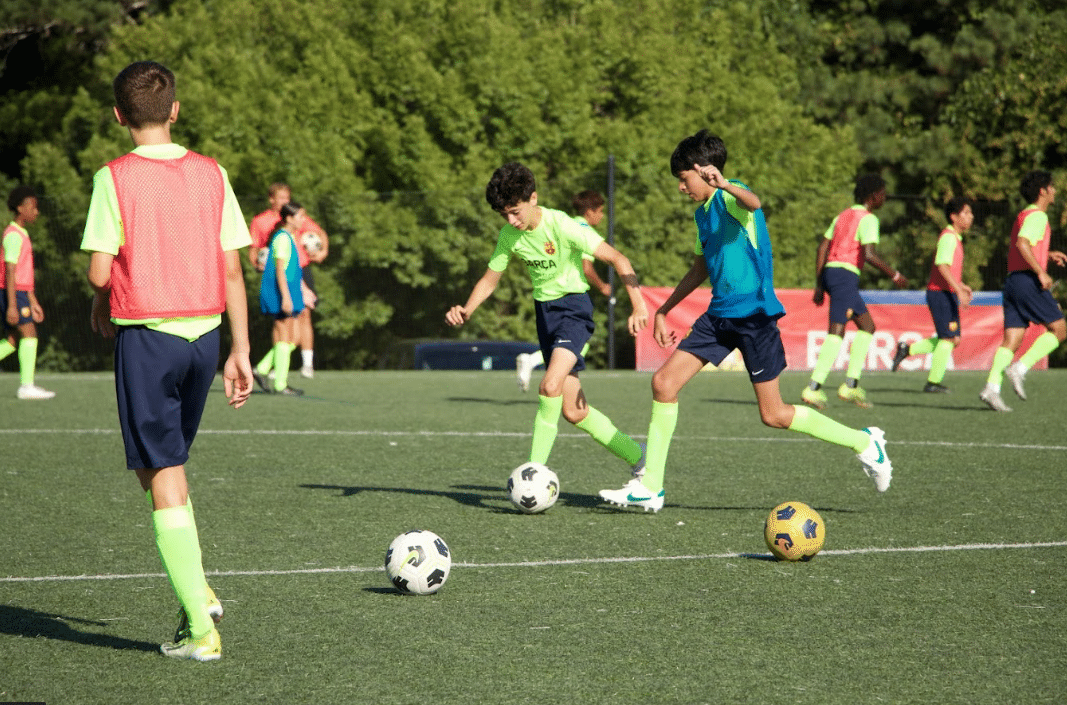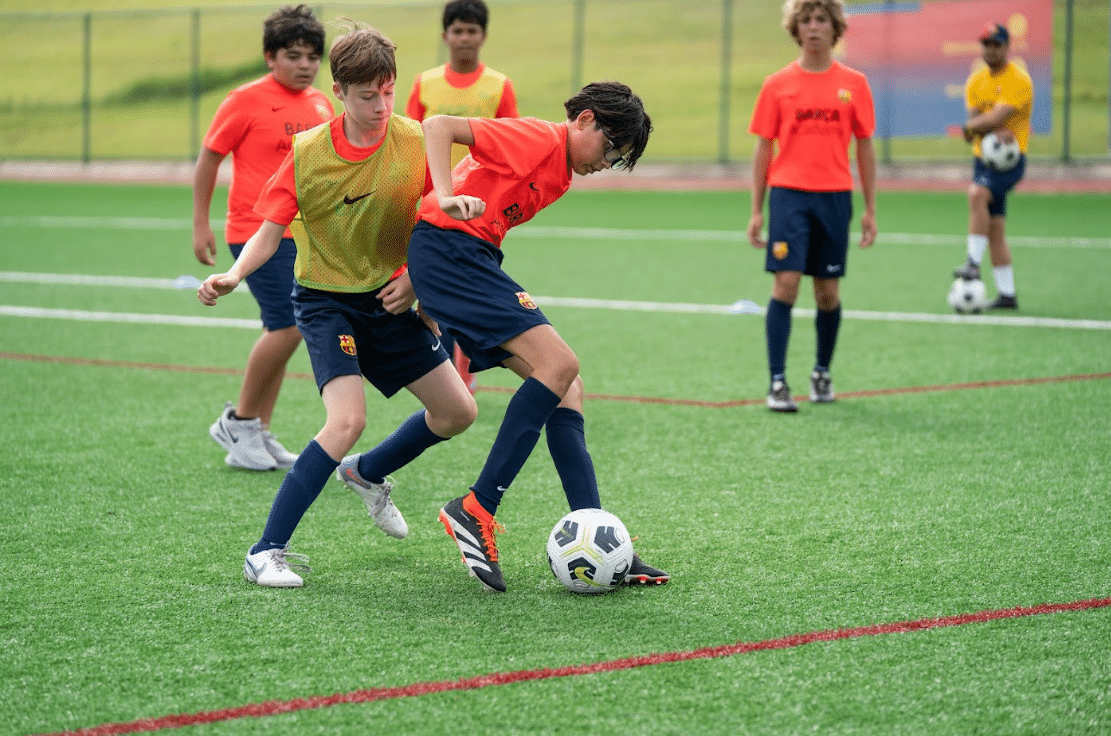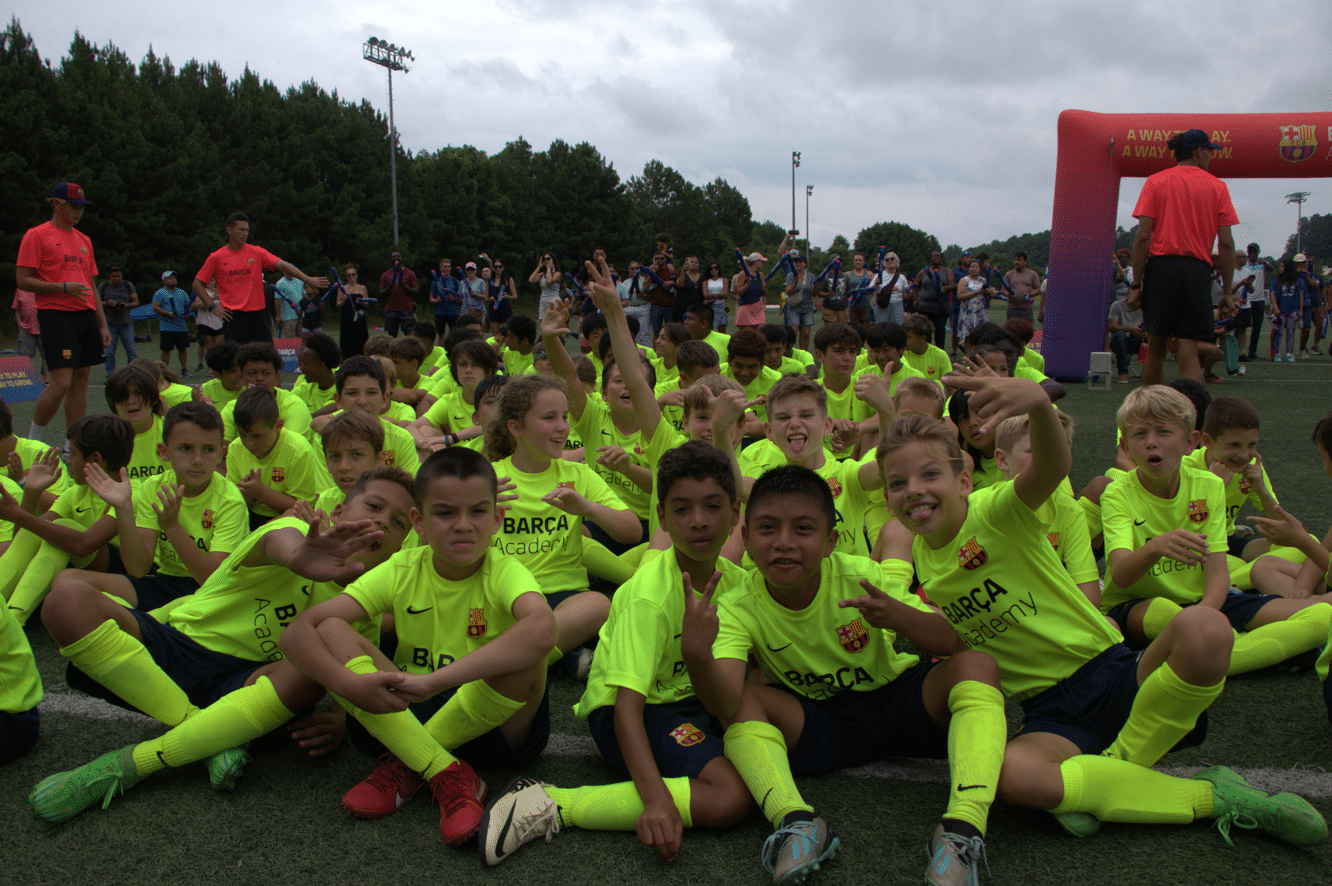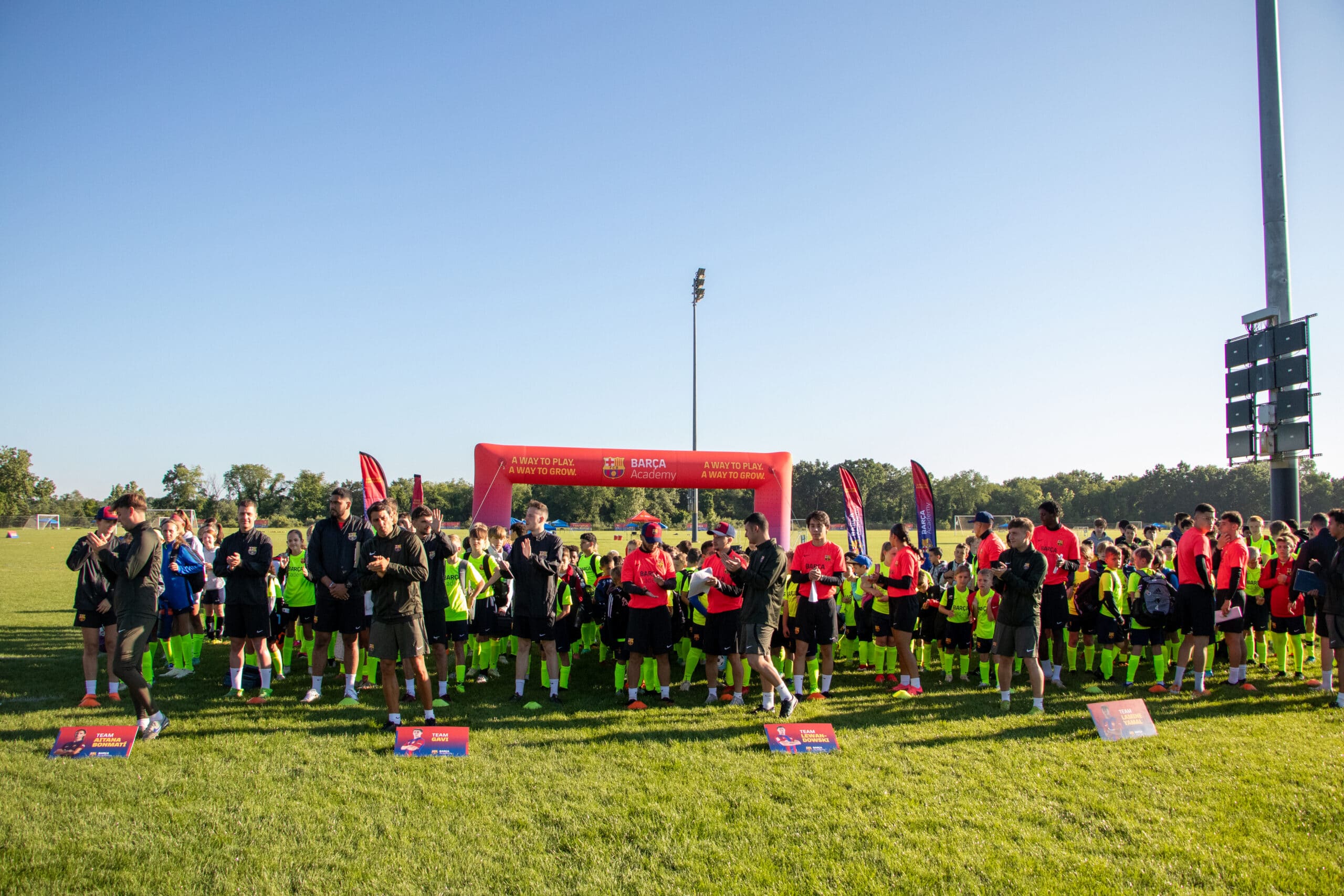

Soccer college recruiting is the multi-year process by which high school and club players get identified, evaluated, and eventually offered a roster spot or an athletic scholarship by a college soccer program. It depends less on a single standout tryout and more on consistent competition, documented development and visibility over time. At Barça Academy USA, we build that foundation year-round, so families walk into the soccer college recruiting process with a player who is technically sound, competition-tested and ready to be evaluated.
Key Points
- ●Soccer college recruiting runs across several years of high school, not a single event, and rewards consistent competitive minutes and documented development over a single standout tryout weekend.
- ●Fewer than 12% of high school soccer players continue at any college level, and under 3% reach NCAA Division I, which is why structured, evaluation-style training matters early – not just during senior year.
- ●Starting in the 2025-26 season, NCAA Division I men’s and women’s soccer moved to a 28-player roster limit with no fixed scholarship cap, replacing the previous 9.9 (men’s) and 14 (women’s) scholarship-equivalency limits.
- ●Barça Academy USA combines the FC Barcelona methodology, UEFA Pro-licensed coaching and a year-round, US-sanctioned competition calendar across four states, giving players the on-field résumé college coaches evaluate.
- ●Our Technical and Development program lets players keep training and competing with their primary club while adding Barça Academy USA sessions, so they don’t lose the recruiting visibility their club or school team already provides.
- ●Selected players also gain international competitive experience through the Barça Academy World Cup in Barcelona – an added credential on a soccer college recruiting profile.
What is soccer college recruiting?
Soccer college recruiting is the process through which college coaches identify, evaluate and ultimately offer a spot to high school or club players, culminating in a verbal commitment, an official offer and, for NCAA Division I and II players, certification through the NCAA Eligibility Center. The process runs through three main governing bodies in the United States — the NCAA, the NAIA and the NJCAA — each with its own divisions, scholarship rules and recruiting calendar.
Most college coaches build their recruiting boards from what they see in sanctioned competition, showcase events and video — not from a single open tryout. A player’s recruiting profile, typically a one-page summary of academic and athletic information plus a highlight video, is what gets a coach to actually attend a game or respond to an email. Soccer college recruiting therefore rewards players who compete consistently in a structured environment where their performance is visible and easy to evaluate.
Why soccer college recruiting keeps getting more competitive
Nearly eight million students play high school sports in the United States, but only around 560,000 go on to compete as NCAA athletes across every sport — a funnel that gets tighter every year as club and academy soccer expand the talent pool coaches can choose from (NCAA, Probability of Competing Beyond High School).
Soccer specifically is no exception. Based on 2022 participation data, roughly 9.74% of boys and 11.29% of girls who play high school soccer go on to compete at any college level — NCAA Division I, II or III, NAIA or NJCAA combined — while only 0.9% of boys and 2.4% of girls reach an NCAA Division I roster (Warubi Sports, college soccer odds).
International recruiting adds another layer of competition: many college programs, especially at the Division I men’s level, fill a meaningful share of their rosters with international players. That is exactly why soccer college recruiting increasingly rewards players who train inside a structured, evaluation-ready system for years, rather than relying on a single camp or a late growth spurt.
How Barça Academy USA prepares young players for the recruiting process
The Barça methodology and UEFA Pro coaching
Every Barça Academy USA session follows the same game model used by FC Barcelona’s own coaching staff, led by a UEFA Pro-licensed Technical Director. That matters for soccer college recruiting because college coaches evaluate technical habits — first touch, decision-making under pressure, positional discipline — not just athleticism. A player trained inside one consistent methodology for several seasons develops those habits in a way that shows up on film.
A structured, year-round competition system
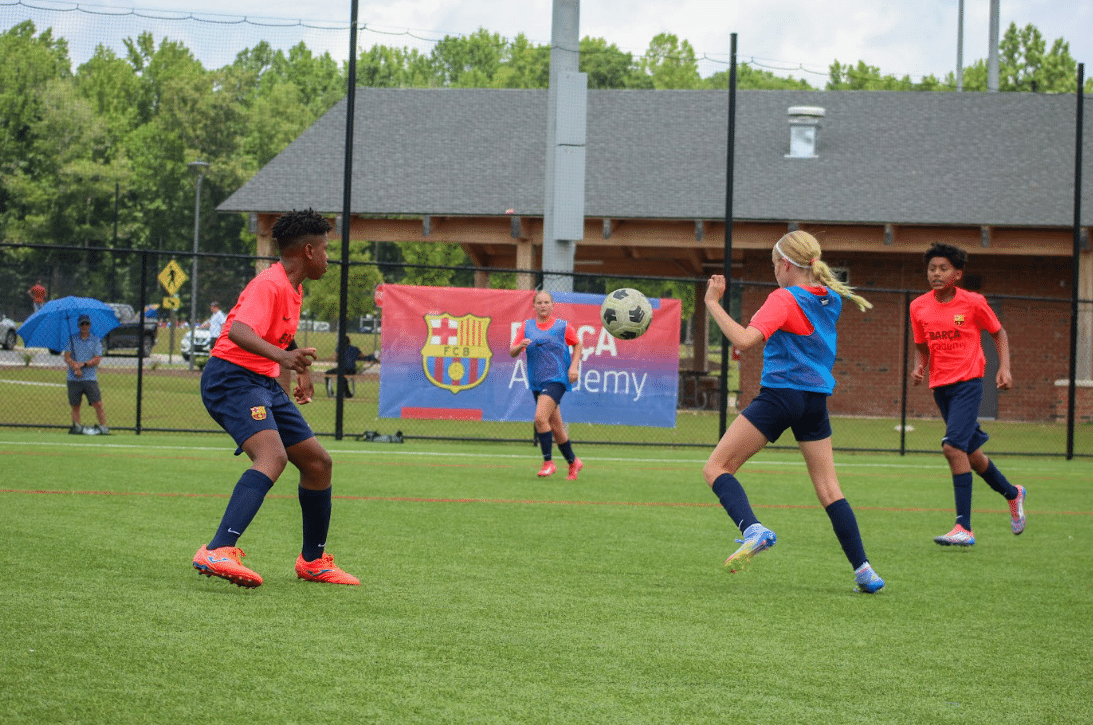
Barça Academy USA currently trains over 2,500 players with more than 50 coaches across 15 training facilities in the Carolinas, Austin (Texas), Chicago (Illinois) and Hoover (Alabama). The program runs a year-round competition system that includes 10 US sanctioned competitions and 5 international tournaments each year, with a coach-to-player ratio of 1-to-12 so every player gets individual attention and evaluable playing time — the same kind of consistent, competitive minutes that a soccer college recruiting profile depends on.
Keep your club, add Barça Academy USA training
Families do not have to choose between their primary club and Barça Academy USA. Through the Technical and Development program, players can continue competing with their existing club — which, for most recruits, remains the main pipeline for exposure to college coaches — while adding Barça Academy USA sessions to raise their technical level. This dual pathway means a player’s recruiting profile and existing competitive history stay intact while their game continues to develop.
International exposure through the Barça Academy World Cup
Select players from Barça Academy USA locations are chosen to train at FC Barcelona’s headquarters and compete in the Barça Academy World Cup in Barcelona, Spain. For a soccer college recruiting profile, that kind of international, invitation-only competitive experience is a differentiator: it signals that a player was selected among peers and has faced a higher level of competition outside their home region.
NCAA divisions and soccer scholarships: what families should know
Soccer is what the NCAA calls an equivalency sport: instead of one full scholarship per player, coaches can split their available aid into partial awards across more of the roster. The scholarship landscape also changed significantly for the 2025-26 season, following the House v. NCAA settlement, which replaced fixed scholarship-equivalency caps with roster limits for Division I programs.
| Level | Scholarship potential | What it means for recruiting |
|---|---|---|
| NCAA Division I | Up to 28 rostered players (men’s & women’s) can receive athletic aid; no fixed scholarship cap as of 2025-26 (previously 9.9 men’s / 14 women’s) | Most competitive level; budgets vary widely by school, so aid amounts differ even within Division I |
| NCAA Division II | Up to 9 full scholarship equivalents per team (men’s & women’s), typically split into partial awards | Strong competition with real scholarship potential; often overlooked by families focused only on D1 |
| NCAA Division III | No athletic scholarships; academic and need-based aid only | Recruiting is academics-first; many D3 programs are highly competitive despite no athletic aid |
| NAIA | Scholarships allowed; limits set by each school and conference | Smaller schools, flexible recruiting rules, real scholarship opportunities |
| NJCAA | Scholarships allowed at many programs | Common two-year pathway that lets players develop and transfer into a four-year program |
Any player targeting NCAA Division I or II must also be certified by the NCAA Eligibility Center, which reviews core-course grades and amateurism status separately from a coach’s athletic evaluation. Academic eligibility and athletic recruiting run on parallel tracks, and missing one can undo progress made on the other.
Building a soccer college recruiting timeline
Soccer college recruiting works best as a multi-year plan rather than a senior-year scramble. Here is a general timeline families can adapt:
| High school year | Recruiting focus |
|---|---|
| Freshman year | Build technical fundamentals and competitive minutes; research target divisions and programs; no direct coach contact needed yet |
| Sophomore year | Create a first highlight video; attend age-appropriate ID camps and showcases; register with the NCAA Eligibility Center if targeting Division I or II |
| Junior year | Contact college coaches directly; attend showcases and camps at target schools; take unofficial visits; keep the Eligibility Center profile updated |
| Senior year | Finalize official visits and offers; confirm academic eligibility is on track; sign a National Letter of Intent or accept an offer |
Common soccer college recruiting mistakes to avoid
- Waiting until senior year to start. Coaches often build their boards one to two years ahead of a signing class.
- Relying on talent alone, without a recruiting profile or highlight video. Coaches cannot evaluate a player they have never seen on film.
- Overlooking academic eligibility. A missed core course or a late Eligibility Center registration can stall an otherwise strong recruiting process.
- Assuming Division I is the only good outcome. Division II, Division III, NAIA and NJCAA all offer real competition, scholarships or clear transfer pathways.
- Chasing one-off camps instead of consistent competition. A single showcase weekend rarely replaces a full season of evaluable, competitive minute.
Frequently asked questions about soccer college recruiting
What age should a player start the soccer college recruiting process?
The soccer college recruiting process typically starts in earnest during a player’s sophomore year of high school, when highlight videos and direct outreach to coaches usually begin — though the technical and competitive foundation that makes recruiting possible should be built years earlier through structured training.
Do college soccer coaches recruit from academies like Barça Academy USA?
College soccer coaches recruit from wherever players get consistent, evaluable competition, including club and academy programs, sanctioned tournaments and showcase events. An academy background with structured coaching and year-round competition gives a player more of the game film and playing history that a recruiting profile depends on.
How many soccer scholarships can an NCAA Division I team offer?
NCAA Division I men’s and women’s soccer teams can now offer athletic aid to any of their 28 rostered players, following the scholarship-cap removal that took effect in the 2025-26 season. Before that change, men’s teams were limited to 9.9 scholarship equivalencies and women’s teams to 14.
Does playing academy soccer instead of high school soccer hurt recruiting?
Playing academy soccer does not hurt soccer college recruiting in most cases, since many college coaches now scout primarily from club, academy and showcase competition rather than high school leagues alone. What matters most is that a player competes consistently against strong opponents in a setting coaches can evaluate.
What is the NCAA Eligibility Center and do soccer recruits need it?
The NCAA Eligibility Center certifies the academic and amateurism status of any player who wants to compete at the NCAA Division I or II level. Soccer recruits targeting those divisions should register during their sophomore or junior year of high school, since certification can take time to complete.
Can international players train at Barça Academy USA and still pursue US college soccer?
International players can train at Barça Academy USA locations in the Carolinas, Austin, Chicago and Hoover while pursuing US college soccer, though international recruits should also register with the NCAA Eligibility Center as international students and confirm their amateurism status separately.
What is a recruiting highlight video and when should it be made?
A recruiting highlight video is a short, edited clip of a player’s best in-game moments that college coaches use for an initial evaluation before attending a live game. Most families put together a first version during the sophomore year and update it each season with new footage.
Is NAIA or NJCAA soccer a good alternative to NCAA Division I?
NAIA and NJCAA soccer are strong alternatives to NCAA Division I, offering athletic scholarships, competitive rosters and, in the case of NJCAA, a common transfer pathway into four-year programs. Many players who don’t land a Division I spot build a stronger recruiting profile at these levels first.
Start your soccer college recruiting journey with Barça Academy USA
Soccer college recruiting rewards players who train and compete consistently over several years, and that is exactly the environment we build at Barça Academy USA. Whether your player is just starting out or already building a recruiting profile, our year-round Academy programs in the Carolinas, Austin, Chicago and Hoover give them the coaching, competition and exposure that college coaches look for. Explore our summer camps and the Barça methodology and values behind every session to see how we build that foundation — and pair it with our soccer nutrition tips for young athletes and strategies to prevent injuries in soccer to keep a recruit healthy and performing through a long season.
Ready to take the next step? Register at your nearest Barça Academy USA location and let our coaches show your player what a soccer college recruiting-ready environment looks like from week one.